To change or not to change
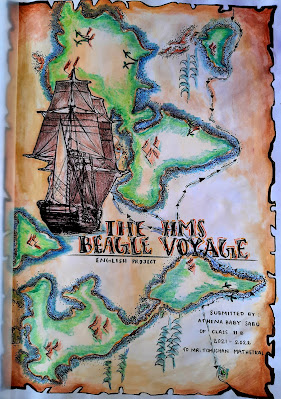 |
| The cover of a project paper by Athena, my student |
Charles Darwin [1809-82] was a
mediocre student at school. His father was a successful and wealthy country
doctor who had high hopes for his son. But Charles seemed determined to shatter
his father’s dreams. Books and theories did not charm him. He loved the
outdoors. He was fascinated by rare beetles, flowers and birds. He watched them
for hours and made notes. His father was not at all amused by all that. “You
care for nothing but shooting, dogs and rat-catching,” the father scolded the
young boy and predicted in no uncertain terms, “You will be a disgrace to yourself
and your family.”
The father
was not going to let the son become such a disgrace, however. He packed him off
to a medical school in Edinburgh to study medicine. But Charles soon dropped
out. Then the father sent him to study for a degree in Cambridge so that the young
man could become a parson. A parson is a respectable member of the society and could
easily earn a good income too. Moreover, he would have enough and more leisure
to collect beetles and watch birds.
At Cambridge,
Charles loved to study botany. Soon he became a friend of Professor Henslow of the
botany department.
It is Prof
Henslow who recommended Charles Darwin for a job on the HMS Beagle, a ship that
was on a several-year long research tour, a journey that would take almost 5 years. The job
offered to Charles was an unpaid one: as a ‘naturalist’ who would be collecting
life and mineral specimens.
Charles
hesitated. He didn’t think he would be at home in the sea and that too for such
a long period. His father objected vehemently too. The vehemence of the
objection aroused the young man’s self-respect. He decided that he should
liberate himself from his domineering father. He said yes to the unpaid job on
the HMS Beagle and embarked upon a voyage that would last nearly five
years.
The voyage
took him to many countries and forests. Charles was amazed by the variety of
life forms he watched in those strange lands of Brazil and Argentina. He
observed the birds and the animals and the plants. And fossils. How did some
species become mere fossils? How did they become extinct, in other words? By
the time the Beagle returned home, Charles Darwin had become a scientist
with a radical theory.
Survival is a
struggle in which many lose out. The fittest survive. It is indeed a harsh
world. Even the giant mastodon will have to surrender in that struggle called
survival. Adapt and evolve. Even mutation becomes inevitable sometimes. Intelligence
is another name for your efficiency at doing the things needed for your
survival.
The young man
who had found Shakespeare “intolerably dull and nauseating” became a scientist with
a radical survival theory. Probably, he had not encountered Shakespeare’s
Hamlet who wondered aloud: “To be or not to be – that is the question.”
 |
| Athena Baby Sabu |
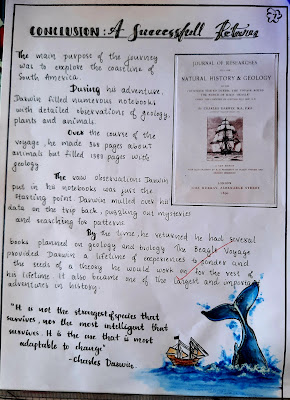
When my student of grade 11, Athena Baby Sabu, chose to do her English project on Charles Darwin’s voyage on the Beagle, I didn’t know what had motivated her. But I loved the project. Particularly the artistic elegance of its presentation. The urge to bring her work to a wider audience became irresistible for me. Athena ends her project with a very significant quote from Darwin: “It is not the strongest of species that survives, nor the most intelligent, it is the one most adaptable to change.” To change or not to change – that is the real question. Especially in our hard times now.
Let me
conclude this with a few pages from Athena’s project work. All the
illustrations are her own art.
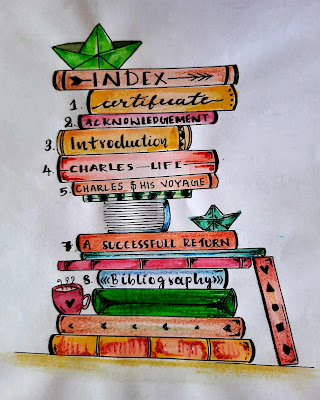 |
| I found this Table of Contents ingenious |
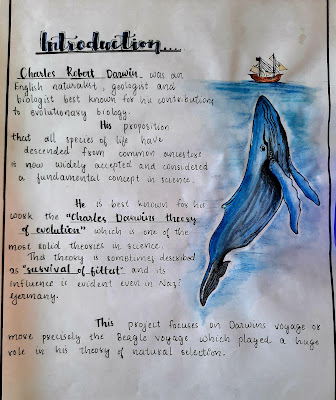
PS. I had
brought in this same space another
project work of this same student two years ago, when she was a student of
my wife.
Hari OM
ReplyDeleteStunning work! Do pass my admiration to Athena. YAM xx
I will definitely.
DeleteWow! Really wonderful Athena! Tom you are lucky to have her as your student. Her work is of the highest calibre.
ReplyDeleteAnd she does it in no time. That's the real miracle.
DeleteCant help marveling at the creativity of your student.. Do convey my appreciation to her.
ReplyDeleteSure.
DeleteWow... amazing work... Loved the illustrations that you have shared... Athena is really talented...
ReplyDeleteUndoubtedly.
DeleteAbsolutely stunning... and yes letting one's passion grow worked for Darwin and it sure will for your student too. These things drives me back home, really wish to be in your class once again.
ReplyDelete😊 Nice to hear that. Covid has altered student behavior drastically. Class is big bore now with masked students sitting indifferent...
DeleteThank you.
ReplyDelete