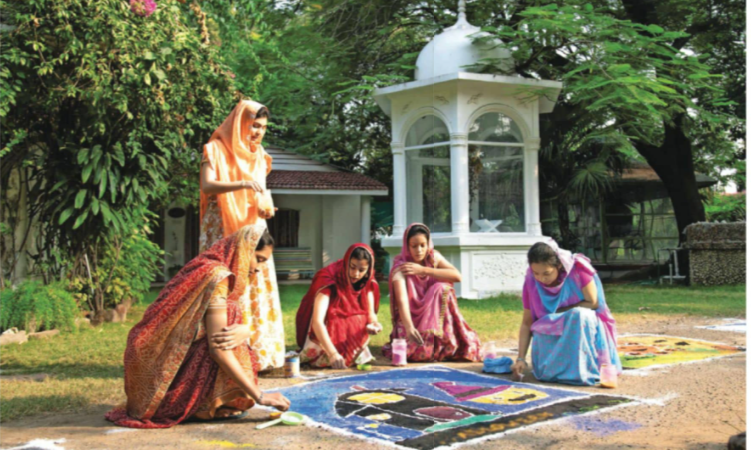
Home of Harmony


Celebration of Diwali at Mahdi Bagh

Media Watch

The latest edition of The Week brings us a delightful article titled ‘Harmony has a home’ written by Sravani Sarkar. It tells us about “India’s smallest known religious sect (that) has set a unique example of peaceful, disciplined living.” The Mahdi Bagh Institution is a tiny community of progressive Muslims who belong to the Atba-e-Malak Badar, the smallest known religious sect in India. The Week focuses on the Nagpur settlement of this community though they have branches in Ujjain, Visakhapatnam, Hyderabad as well as California and Sharjah. They are essentially Muslims but with some differences. They believe that salvation is possible only through the daee, the community’s infallible spiritual master.

The Mahdi Bagh Institution in Nagpur is spread over 25 acres. Each family has a separate residence. But there are no boundary walls between them. The houses are never locked. It is like a private township with its own traffic system, water and power supply, rainwater harvesting facility, dispensary and a community hall. They have a swimming pool, a fishing pond, golf course, cricket and football grounds, tennis court, volleyball and badminton courts and indoor games facilities. The entire campus is maintained meticulously and it is a kind of paradise on earth. 

A newly wed couple

The people are guided by the principles of peace, simplicity, love, brotherhood, gender equality and respect for all faiths. Not every child born to the members automatically becomes a member of this community. The child has to grow up and make a choice as an adult, a choice made on the basis of understanding and accepting the community’s fundamental spiritual beliefs and principles.

The community is neither exclusivist nor expansionist. They accept individuals from outside through marriage. But once again the individual has to make a personal choice, a commitment. 

Maulana Amiruddin Malak Saheb, present spiritual head

I have always believed that if the systems are good the individuals will be good too. In other words, if our socio-political setup encourages compassion and generosity, there will be compassion and generosity around. People like to be good. But they need the support of the systems. Why is there so much evil around? My firm conviction is that our systems foster evils. Just look at the present India. Isn’t it founded on hatred and mutual distrust? Aren’t we told and taught to hate rather than love? Aren’t we taught to dig up ancient hatreds and hug the blood-hungry ghosts?

Institutions like the one highlighted above show us that goodness is not necessarily a dream.

PS. All pictures above are from The Week.

Comments

  1. Hari OM
    An intriguing example of how to live life differently. YAM xx

    ReplyDelete
    Replies
    1. PS - my comment yesterday has not appeared - do check your spam comments folder; Blogger has been playing some tricks with everyone's comments this past couple of months. Yxx

      Delete
    2. It's good to know that such communities exist. They give us hope.

      Delete
  2. This is interesting and informative. I never knew about this sect.The best part is ..... the child has to grow up and make a choice as an adult....... All said and done, The Week always comes out with unique articles.

    ReplyDelete
    Replies
    1. I wasn't aware of this sect too. Communities like this offer hope for a better world.

      Delete
  3. I think I heard about bohra muslims but not this...sounds cool specially the act of leaving the choice to kids till they grow .
    ......before they choose a religion....wish they had an option to not choose at all...they must be having ....but what if even normal muslims are just as open as this and keep religion very personal....u think they are very minimal and exceptional group ?? :( Among many I kno there r ignorant but mostly submissive sect who keep religion inside doors but ya I kno there r some frenzy folks...however good to kno that some people are called *progressive muslims* specifically :) this is afshan
    ..unable to comment with my profile

    ReplyDelete
    Replies
    1. Religion should have become defunct long ago. That's my personal view. Religion does more harm than good whether Islam, Hinduism or Christianity. In such a world where gods are pernicious, sects like this Mahdi Bagh become significant. They show that religion needn't be so abhorrent.

      Delete
    2. That's true! I agree

      Delete
  4. Good to know about this progressive community...

    ReplyDelete

Post a Comment

Popular posts from this blog

The Adventures of Toto as a comic strip

  'The Adventures of Toto' is an amusing story by Ruskin Bond. It is prescribed as a lesson in CBSE's English course for class 9. Maggie asked her students to do a project on some of the lessons and Femi George's work is what I would like to present here. Femi converted the story into a beautiful comic strip. Her work will speak for itself and let me present it below.  Femi George Student of Carmel Public School, Vazhakulam, Kerala Similar post: The Little Girl

The Ugly Duckling

Source: Acting Company A. A. Milne’s one-act play, The Ugly Duckling , acquired a classical status because of the hearty humour used to present a profound theme. The King and the Queen are worried because their daughter Camilla is too ugly to get a suitor. In spite of all the devious strategies employed by the King and his Chancellor, the princess remained unmarried. Camilla was blessed with a unique beauty by her two godmothers but no one could see any beauty in her physical appearance. She has an exquisitely beautiful character. What use is character? The King asks. The play is an answer to that question. Character plays the most crucial role in our moral science books and traditional rhetoric, religious scriptures and homilies. When it comes to practical life, we look for other things such as wealth, social rank, physical looks, and so on. As the King says in this play, “If a girl is beautiful, it is easy to assume that she has, tucked away inside her, an equally beauti...

Indian Knowledge Systems

Shashi Tharoor wrote a massive book back in 2018 to explore the paradoxes that constitute the man called Narendra Modi. Paradoxes dominate present Indian politics. One of them is what’s called the Indian Knowledge Systems (IKS). What constitute the paradox here are two parallel realities: one genuinely valuable, and the other deeply regressive. The contributions of Aryabhata and Brahmagupta to mathematics, Panini to linguistics, Vedanta to philosophy, and Ayurveda to medicine are genuine traditions that may deserve due attention. But there’s a hijacked version of IKS which is a hilariously, if not villainously, political project. Much of what is now packaged as IKS in government documents, school curricula, and propaganda includes mythological claims treated as historical facts, pseudoscience (e.g., Ravana’s Pushpaka Vimana as a real aircraft or Ganesha’s trunk as a product of plastic surgery), astrology replacing astronomy, ritualism replacing reasoning, attempts to invent the r...

Waiting for the Mahatma

Book Review I read this book purely by chance. R K Narayan is not a writer whom I would choose for any reason whatever. He is too simple, simplistic. I was at school on Saturday last and I suddenly found myself without anything to do though I was on duty. Some duties are like that: like a traffic policeman’s duty on a road without any traffic! So I went up to the school library and picked up a book which looked clean. It happened to be Waiting for the Mahatma by R K Narayan. A small book of 200 pages which I almost finished reading on the same day. The novel was originally published in 1955, written probably as a tribute to Mahatma Gandhi and India’s struggle for independence. The edition that I read is a later reprint by Penguin Classics. Twenty-year-old Sriram is the protagonist though Gandhi towers above everybody else in the novel just as he did in India of the independence-struggle years. Sriram who lives with his grandmother inherits significant wealth when he turns 20. Hi...

Ghost with a Cat

It was about midnight when Kuriako stopped his car near the roadside eatery known as thattukada in Kerala. He still had another 27 kilometres to go, according to Google Map. Since Google Map had taken him to nowhere lands many a time, Kuriako didn’t commit himself much to that technology. He would rather rely on wayside shopkeepers. Moreover, he needed a cup of lemon tea. ‘How far is Anakkad from here?’ Kuriako asked the tea-vendor. Anakkad is where his friend Varghese lived. The two friends would be meeting after many years now. Both had taken voluntary retirement five years ago from their tedious and rather absurd clerical jobs in a government industry and hadn’t met each other ever since. Varghese abandoned all connection with human civilisation, which he viewed as savagery of the most brutal sort, and went to live in a forest with only the hill tribe people in the neighbourhood. The tribal folk didn’t bother him at all; they had their own occupations. Varghese bought a plot ...