What’s in a dog’s name?
 |
| Bruno poses for me |
Bruno is the name of the
only favourite dog on my school’s campus.
He has been on the campus for more years than I can trace my memory back
to. Recently he posed for two snaps for
me. He was so meek and obedient when I
approached with my mobile phone’s camera, when the sun had already set far
below the horizon, that I began to wonder who gave him the name of Bruno.
The Western Christians
gave the name Bruno to dogs in the olden days in order to disparage the great philosopher,
mathematician, astrologer and poet of the same name who was burnt to death as a
heretic by the Catholic church in the year 1600. Bruno, according to the Catholic church, was
teaching things that went against the teachings of the Bible. It was Bruno who taught Galileo Galilei
(1564-1642) to recant his science for the sake of religion so that he could
say, “Religion teaches how to go to heaven, science teaches how the heavens go.”
[I have taken a little liberty with what he actually said: replace the word
religion with ‘the Bible’ and you’ll get what Galileo actually said.]
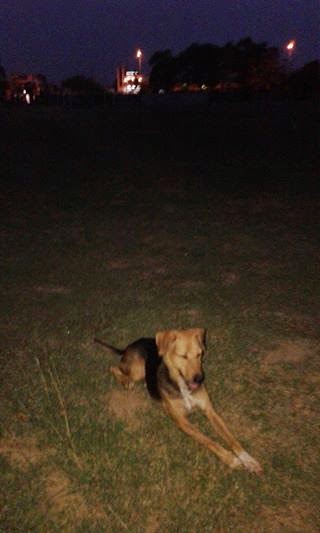 |
| He loved the attention. |
Who on my campus could
have thought of Bruno as a name for such a meek dog when the real Bruno was a
rebel who died for the truth?
Some questions have no
answers.
Do dogs’ names actually
mean anything? As Shakespeare asked, “What’s
in a name?” Especially a dog’s?
In my childhood I knew
quite a few dogs in my village which were named Kaiser. In fact, the owners of those dogs could have
known nothing about Kaiser being the German emperor in the olden days. Probably, the British in India had named some
of their dogs Kaiser just as some other people of the West named their dogs
Bruno. And the people of my village
might have plagiarised the name with the naiveté that usually and magnanimously
accompanies snobs and dumb wits.
I’m not a lover of animals
at all except from a considerable distance.
I like to watch them from far.
Especially if they are in the cage in some zoo. Safe distance is what I desire when it comes
to animals. [Even people J ] The only time that an
animal’s death elicited some feelings from my recalcitrant heart was when I was
about seven or eight years old. My
father had ordered our domestic assistant to kill our family dog named
Jimmy. I pleaded with the young man not
to kill the dog. I had grown up feeding
it and playing with it as much as the ferocious creature allowed me to. My tears did not last longer than the dog’s
burial in the evening. But I have
wondered time and again why my father had named the dog Jimmy. Jimmy Carter became the President of America quite
a few years after the dog’s assassination.
A few years ago, when I
visited my village my brother’s children were fondling a puppy. I asked them what name they had given to the
puppy. Nothing, they said. I suggested the name Larry
spontaneously. “What a stupid name!” my
nephew and niece said simultaneously. They
continued to call the puppy ‘Putti’ which is the simplest Malayalam equivalent
of the Hindi ‘Kuta’. And,
understandably, Putti was not there when I visited the village the next
time. There were three other dogs (two of which were German shepherds) each
of which had an exotic name. Nothing can
last without a name. I wondered more
than once why I had suggested that name for the putti. It took me a while to
remember that Larry was the name of the person to whom I had dedicated a book
of mine. The book contained short
stories I had written while I was going through the toughest time of my life.
So, what’s in a name? Especially a dog’s?
I dedicate this post to
Bruno who is a hero on the campus.
Interesting words on a dog...in fact,no one cares a dog that much...a real tribute to dog world.:)
ReplyDeleteThere are people who care a lot for their own dogs. But Bruno in this post is cared for by a lot of people.
DeleteIt's amazing to know how Bruno came to be a name associated with the dogs. But then, I agree, what's in a name. A hero will always be a hero, no matter what the name. Interesting post; Bruno looks adorable.
ReplyDeleteNames make people as well as animals unique individuals. So there's much in a name. But, of course, the history of the name doesn't matter really.
DeleteThis comment has been removed by the author.
ReplyDeleteCant bear the thought of a dog bein assassinated....but why did your dad do so ? though I love all the animals byt dogs are my hot fav...just like u i maintain distance from human beings but i get too too attached to dogs , i love to pamper them...they sleep in my bed , they eat in my plate ...and it does not apply to my pet dogs alone but I like to cuddle and take care of any dog immaterial of name , breed etc etc.
DeleteAlka, doing away with aged animals was a common practice in villages in those days, a kind of euthanasia. Nothing surprising about it. Conditions were such that dying animals could be a serious health hazard for people in days when vets were not available easily. The practice has not vanished from villages even today, I believe.
DeleteAlka, doing away with aged animals was a common practice in villages in those days, a kind of euthanasia. Nothing surprising about it. Conditions were such that dying animals could be a serious health hazard for people in days when vets were not available easily. The practice has not vanished from villages even today, I believe.
DeleteI love dogs passionately. YOur story about Jimmy being assassinated is extremely disturbing.
ReplyDeleteSecondly - would you like to be called Matthias instead of Matheikal? I guess not. A dog;s name is his identity. It's important to him.
That happened almost half a century ago in a remote village, Kalpana. The world was a different place then. Circumstances demanded certain killings. Otherwise there would be greater evils.
DeleteInteresting post.. Just to tickle a bone, there is an old joke. A man was standing along with his dog when a passerby asked its name. "William bell". The passerby was amused so he went on asking the man's name and he replied "Bruno" :)
ReplyDeleteThanks for the tickling joke, Roohi.
DeleteGreat post! Choosing the perfect name for both male and female dogs can be surprisingly challenging, especially with so many great options out there. I like how you’ve included a mix of classic, modern, and unique names—it really helps different pet owners find something that truly matches their dog’s personality.
ReplyDeleteFrom my experience, shorter and easy-to-pronounce names work best for training, while personality-based names always leave a lasting impression. It’s also interesting to see how naming trends evolve over time.
For anyone still exploring more ideas, I’ve also come across helpful resources like femaledognames.net, which organize names into categories and trends, making the process a bit easier. Overall, this is a well-structured and useful list—great work!