
Will saffron continue to darken India?
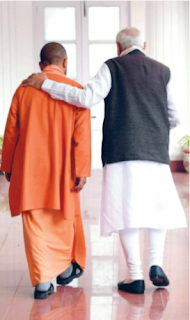


Five states are going to the polls next month and four of them are being ruled by the saffron party. Will saffron continue to cast its dark shadows there?

If the voters go by reason rather than by religious sentiments, the BJP will not have a cat in hell’s chance of winning. But do voters ever go by reason, especially in a state like UP? Already hate speeches are flowing like venomous rivers in that state. And most of the speakers are ‘holy’ people! Let us not forget that the massive victory of the BJP in the 2014 general elections was preceded by a murderous communal riot in UP’s Muzaffarpur. Now the BJP is trying to do the same thing all over again. There have been open calls for genocide against Muslims from BJP leaders and others like sadhus. Repressive measures are being taken against minority institutions like those of the Missionaries of Charity. A lot of Christian churches and schools were attacked recently in many North Indian states.

When you have nothing to show for progress and development, bring in communal hatred and violence. Modi has done this again and again, right from the post-Godhra days in Gujarat.

What a pathetic governance has it been after those events in Gujarat which made Modi the Hindu Hriday Samrat!


One lakh farmers committed suicide during Modi’s reign, from 2014-2021. Lakhs of Adivasi and Dalit children die due to poverty and malnutrition in Modi’s India. There is severe unemployment. There are serious economic problems in every state. The prices of essential commodities keep rising day by day and the government doesn’t seem to give two hoots. Yes, the PM cares for one particular group of people: the corporate sector. Their loans amounting to a whopping Rs 10.72 lakh crore was written off. When the poor farmers demanded the waiving of their meagre loans, Modi said there was no money for that.

Modi has no money for the poor. He has money, thousands of crores, to advertise himself, to go on foreign tours, to refurbish his wardrobe, to build a splendorous palace for himself in Delhi…

The people of Punjab are not likely to vote for Modi’s party in the coming election there. They did not even allow Modi to move on their road. More informed people say that Modi did not want to move and the alleged threat to his life was only sheer drama. The actual reason was that only 3,000 people were attending the meeting for which 70,000 chairs had been arranged. Punjab has rejected Modi, in other words.

Will UP vote for him? Well, possibly yes. That’s a state where religious frenzy decides too many things. But the western UP’s farmers are not likely to vote for Modi. And that region has as many as 135 seats. And then there is the Akhilesh Yadav factor which cannot be ignored. He seems to be offering better things to the people of UP than dead bodies floating in the Ganga and children dying in hospitals.

I’d certainly love to see Goa, Manipur and Uttarakhand exhibiting more sense than UP.

Comments

  1. Hari OM
    Politics... another name for a minfield... YAM xx

    ReplyDelete
  2. Fear the worst and hope for the best.

    ReplyDelete
  3. I believe sense would prevail now. Other than their strong hold state, other states would give them a tough time

    ReplyDelete
    Replies
    1. I too hope fervently that the voters make use of their brains this time for a change.

      Delete
  4. haa! politics the final refuge of the thieves.

    ReplyDelete

Post a Comment

Popular posts from this blog

The Adventures of Toto as a comic strip

  'The Adventures of Toto' is an amusing story by Ruskin Bond. It is prescribed as a lesson in CBSE's English course for class 9. Maggie asked her students to do a project on some of the lessons and Femi George's work is what I would like to present here. Femi converted the story into a beautiful comic strip. Her work will speak for itself and let me present it below.  Femi George Student of Carmel Public School, Vazhakulam, Kerala Similar post: The Little Girl

Re-exploring the Past: The Fort Kochi Chapters – 4

The footpath between Park Avenue and Subhash Bose Park The Park Avenue in Ernakulam is flanked by gigantic rain trees with their branches arching over the road like a cathedral of green. They were not so domineering four decades ago when I used to walk beneath their growing canopies. The Park Avenue with its charming, enormous trees has a history too. King Rama Varma of Kochi ordered trees to be planted on either side of the road and make it look like a European avenue. He also developed a park beside it. The park was named after him, though today it is divided into two parts, with one part named after Subhash Chandra Bose and the other after Indira Gandhi. We can never say how long Indira Gandhi’s name will remain there. Even Sardar Patel, whom the right wing apparently admires, was ousted from the world’s biggest cricket stadium which was renamed Narendra Modi Stadium by Narendra Modi.   Renaming places and roads and institutions is one of the favourite pastimes of the pres...

Re-exploring the Past: The Fort Kochi Chapters – 3

Street leading to St Francis Church, Fort Kochi There were Christians in Kerala long before the Brahmins, who came to be known as Namboothiris, landed in the state from North India some time after 6 th century CE. Tradition has it that Thomas, disciple of Jesus, brought Christianity to Kerala in the first century. That is quite possible, given the trade relationships that Kerala had with the Roman Empire in those days. Pliny the Elder, Roman author, chastised in his encyclopaedic work, Natural History (published around 77 CE), the Romans’ greed for pepper from India. He was displeased with his country spending “no less than fifty million sesterces” on a commodity which had no value other than its “certain pungency.” Did Thomas sail on one of the many ships that came to Kerala to purchase “pungency”? Possible.   Even if Thomas did not come, the advent of Christianity in Kerala precedes the arrival of the Namboothiris. The Persians established trade links with Kerala in 4 ...

Five Microtales

1.        Development             Chamar, Lohar, Mehtar and many others stood at a distance, along with their families, and watched their huts being pulled down by a bulldozer. They were asked to leave the place where they had been living for decades. “The government has taken over this land for development works,” an officer said. Chamar, Lohar, Mehtar and the others spread their bedsheets under a flyover over which flew opulent vehicles of development.   2.        Impersonation             The old woman went to the Women’s Welfare office. She wanted to register herself for the Prime Minister’s monthly welfare scheme for the old and unemployable women. She placed her thumb on the scanner for Aadhar authentication. “Not matching,” the officer said. She was arrested for trying to impersonate. Sitti...

Re-exploring the Past: The Fort Kochi Chapters – 1

Inside St Francis Church, Fort Kochi Moraes Zogoiby (Moor), the narrator-protagonist of Salman Rushdie’s iconic novel The Moor’s Last Sigh , carries in his genes a richly variegated lineage. His mother, Aurora da Gama, belongs to the da Gama family of Kochi, who claim descent from none less than Vasco da Gama, the historical Portuguese Catholic explorer. Abraham Zogoiby, his father, is a Jew whose family originally belonged to Spain from where they were expelled by the Catholic Inquisition. Kochi welcomed all the Jews who arrived there in 1492 from Spain. Vasco da Gama landed on the Malabar coast of Kerala in 1498. Today’s Fort Kochi carries the history of all those arrivals and subsequent mingling of history and miscegenation of races. Kochi’s history is intertwined with that of the Portuguese, the Dutch, the British, the Arbas, the Jews, and the Chinese. No culture is a sacrosanct monolith that can remain untouched by other cultures that keep coming in from all over the world. ...