Forest of Longings


Nisargadhama's longings
Nisargadhama forest is one of the tourist attractions in Kodagu, Karnataka. It is an island formed by the river Kaveri.  What you see everywhere on this 64-acre island are bamboos.  There are also some sandalwood and teak trees.  As you walk along the mud track, some deer will gaze at you with a strange longing in their eyes.  Their gaze looks plaintive. 

You enter this forest through a narrow hanging bridge which raises your hopes if not dreams.  You walk along chasing those hopes or dreams.  Bamboos blink at you everywhere. An air of desolation overwhelms you slowly.  You long for something more than bamboos.  More than the wistfulness in the doleful eyes of the deer.
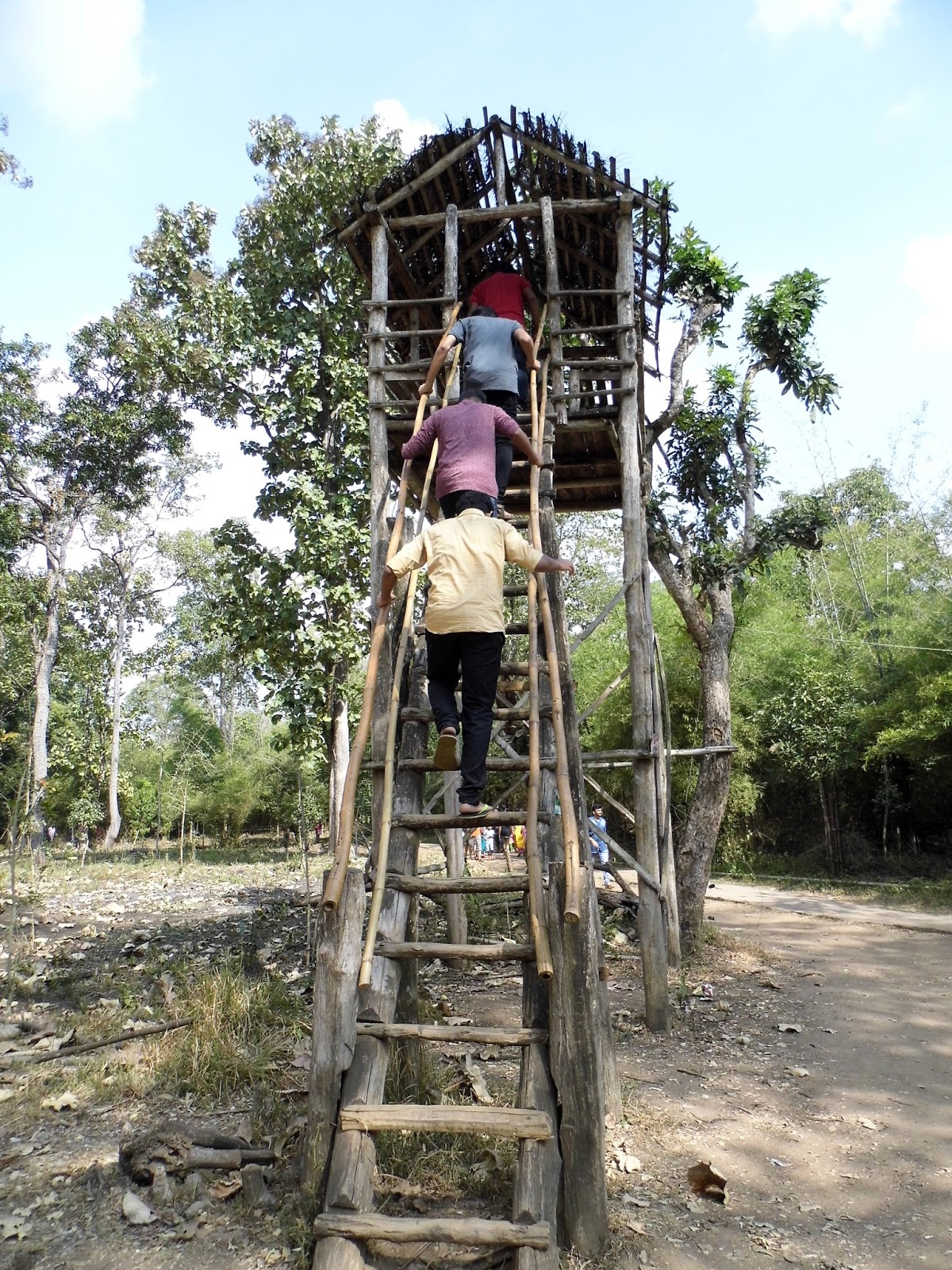
One of the many huts on the way
For a change you can choose an elephant ride.  Or maybe look out for a peacock.  The easiest diversion will be the elevated huts.  Climb up and then climb down.  Back on the mud track, philosophise about life’s inevitable ups and downs.

Take the path leading to the river.  You can step into the water.  Wet yourself.  Immerse yourself if you are in the mood. It’s precious water.  It’s the water for which Karnataka and Tamil Nadu have fought many a battle.  It is the symbol of an endless conflict, endless human wants.  You can remember the other conflict that Tamil Nadu sustains in Kerala for water from the Mullaperiyar dam.  You can contemplate on the history of human struggles.

Kaveri
Of human longings.  Nisargadhama is a forest of longings.  You can feel its uneasy breathing.  A suffocation that chokes the air passage within you.  You realise that the mud track beneath you has raised enough dust to block your nostrils.  Take out the Otrivin phial that accompanies you like a faithful companion and squeeze the drops into the ducts that connect your life with the universe. 

What nasal drops can save the universe?  Kaveri gurgles down.  Longing to revitalise the universe, perhaps.  But she is powerless.  Power belongs to the biped whose longings have no end.


PS. I visited the place on 31 Oct 2016 along with a group of students of mine. 

At the Harangi dam across a tributary of Kaveri

Indian Bloggers


Comments

  1. It is indeed a charming forest location. I worked for seven years in Karnataka, and, visited many places,but some how could not get info about this spot !

    ReplyDelete
    Replies
    1. The river makes it charming. Maybe it has seasonal charms too of which I'm not aware.

      Delete
  2. Lovely description!
    The powerful, longing biped are crippling the Ganga and Yamuna too:(

    ReplyDelete
  3. Good travelogue. :)
    I like the humor you put in mentioning the war over waters.

    ReplyDelete
  4. नोटबंदी के बाद डिजिटल पेमेंट पर जोर, जानें क्या है डिजिटल पेमेंट
    Readmore Todaynews18.com https://goo.gl/BgzxC9

    ReplyDelete

Post a Comment

Popular posts from this blog

The Adventures of Toto as a comic strip

  'The Adventures of Toto' is an amusing story by Ruskin Bond. It is prescribed as a lesson in CBSE's English course for class 9. Maggie asked her students to do a project on some of the lessons and Femi George's work is what I would like to present here. Femi converted the story into a beautiful comic strip. Her work will speak for itself and let me present it below.  Femi George Student of Carmel Public School, Vazhakulam, Kerala Similar post: The Little Girl

The Ugly Duckling

Source: Acting Company A. A. Milne’s one-act play, The Ugly Duckling , acquired a classical status because of the hearty humour used to present a profound theme. The King and the Queen are worried because their daughter Camilla is too ugly to get a suitor. In spite of all the devious strategies employed by the King and his Chancellor, the princess remained unmarried. Camilla was blessed with a unique beauty by her two godmothers but no one could see any beauty in her physical appearance. She has an exquisitely beautiful character. What use is character? The King asks. The play is an answer to that question. Character plays the most crucial role in our moral science books and traditional rhetoric, religious scriptures and homilies. When it comes to practical life, we look for other things such as wealth, social rank, physical looks, and so on. As the King says in this play, “If a girl is beautiful, it is easy to assume that she has, tucked away inside her, an equally beauti...

Indian Knowledge Systems

Shashi Tharoor wrote a massive book back in 2018 to explore the paradoxes that constitute the man called Narendra Modi. Paradoxes dominate present Indian politics. One of them is what’s called the Indian Knowledge Systems (IKS). What constitute the paradox here are two parallel realities: one genuinely valuable, and the other deeply regressive. The contributions of Aryabhata and Brahmagupta to mathematics, Panini to linguistics, Vedanta to philosophy, and Ayurveda to medicine are genuine traditions that may deserve due attention. But there’s a hijacked version of IKS which is a hilariously, if not villainously, political project. Much of what is now packaged as IKS in government documents, school curricula, and propaganda includes mythological claims treated as historical facts, pseudoscience (e.g., Ravana’s Pushpaka Vimana as a real aircraft or Ganesha’s trunk as a product of plastic surgery), astrology replacing astronomy, ritualism replacing reasoning, attempts to invent the r...

Waiting for the Mahatma

Book Review I read this book purely by chance. R K Narayan is not a writer whom I would choose for any reason whatever. He is too simple, simplistic. I was at school on Saturday last and I suddenly found myself without anything to do though I was on duty. Some duties are like that: like a traffic policeman’s duty on a road without any traffic! So I went up to the school library and picked up a book which looked clean. It happened to be Waiting for the Mahatma by R K Narayan. A small book of 200 pages which I almost finished reading on the same day. The novel was originally published in 1955, written probably as a tribute to Mahatma Gandhi and India’s struggle for independence. The edition that I read is a later reprint by Penguin Classics. Twenty-year-old Sriram is the protagonist though Gandhi towers above everybody else in the novel just as he did in India of the independence-struggle years. Sriram who lives with his grandmother inherits significant wealth when he turns 20. Hi...

Ghost with a Cat

It was about midnight when Kuriako stopped his car near the roadside eatery known as thattukada in Kerala. He still had another 27 kilometres to go, according to Google Map. Since Google Map had taken him to nowhere lands many a time, Kuriako didn’t commit himself much to that technology. He would rather rely on wayside shopkeepers. Moreover, he needed a cup of lemon tea. ‘How far is Anakkad from here?’ Kuriako asked the tea-vendor. Anakkad is where his friend Varghese lived. The two friends would be meeting after many years now. Both had taken voluntary retirement five years ago from their tedious and rather absurd clerical jobs in a government industry and hadn’t met each other ever since. Varghese abandoned all connection with human civilisation, which he viewed as savagery of the most brutal sort, and went to live in a forest with only the hill tribe people in the neighbourhood. The tribal folk didn’t bother him at all; they had their own occupations. Varghese bought a plot ...