
Media in Modi’s India
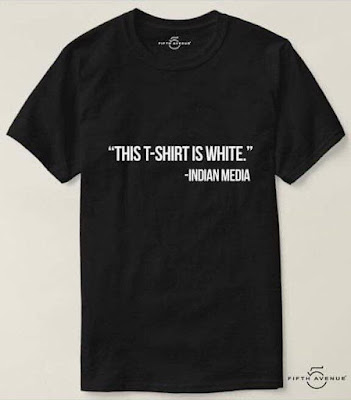


Freedom of the press is dying in Modi’s India rather quickly. The World Press Freedom Index ranks India very low at 142 out of 180 countries. The rank deteriorated consistently from the time Modi became the Prime Minister. The Press Council of India, a state-owned body, accepts that there is unwarranted censorship of the media in the country. There are various types of “intimidation” of journalists and news agencies.

Both human rights and press freedom have crumbled in India faster than in any other country. “Freedom of expression is a precondition for democracy and lasting peace,” The Nobel Peace Prize Committee said while awarding the prize last year to Maria Ressa and Dmitry Muratov “for their courageous fight for freedom of expression in the Philippines and Russia.” The Committee went on to say that these two are “representatives of all journalists who stand up for this ideal in a world in which democracy and freedom of the press face increasingly adverse conditions.” India has entered the watchlist of international observers of democracy and press freedom.

Several journalists in India have been subjected to various forms of harassment by the government. Many faced intimidation including death and rape threats. Bobby Ghosh, editor of the Hindustan Times had to resign when he opened a portal called the Hate Tracker on the newspaper’s website. Hate Tracker was a database for tracking violent crimes motivated by race, religion and sexual orientation. It should be recalled that Ghosh resigned just after Modi visited the owner of the newspaper.

Journalists like Gauri Lankesh were brutally killed for reporting truths which were supposedly antinational. At least 40 journalists were killed and 200 were attacked between 2014 and 2019, according to a report. The new press accreditation policy ensures that more and more journalists will face serious consequences if they report truths which are unpalatable for the government. If a journalist “acts in manner which is prejudicial to the sovereignty and integrity of India, the security of the state, friendly relations with foreign states, public order, decency or morality or in relation to contempt of court, defamation or incitement of an offence,” his/her accreditation will be cancelled. The intent is crystal clear. And ominous too.

India Digital News Report from the illustrious Reuters Institute says that the India media is fast losing credibility. According to this report, only 38% of Indians trust news now.

Recently a Malayalam TV channel named Media One was shut down as the government refused to renew its license. Reason: it gave to its viewers accurate reports about the attacks on Muslims in Delhi in 2020. What is bizarre is that the High Court quoted the Rig Veda to justify the government’s action against the channel. Will we have the Vedas as our Constitution soon?

Media's Deadly Dilemmas

xZx


Comments

  1. Hari Om
    It keeps happening, but all that is done is it is on 'watchlist'... and to quote from scripture in this case? Clear misuse and twisting of words yet again.

    Oh a cheerful note - you have a new kitty!!! YAM xx

    ReplyDelete
    Replies
    1. Our newspapers get 70% of their income from ads and government is the biggest advertiser. That's an added reason for appeasement coverage.

      It's an old pic. This one grew up and is mother of 4 kittens now.

      Delete
  2. When the judiciary has failed the citizens and a large section of press has opted for the servility of those in power (for the sake of material gains, survival in a competitive market or the like wise), what's the solution ? Who can play David for this Goliath (who, ironically, pretends to be David to fool the people) ?

    ReplyDelete
  3. I'll be happy if all news channels - pro-left/pro-right/pro-center - are muted. Let's go back to newspaper era. Overdose!

    ReplyDelete
  4. I thus get most of my news from newspapers and digital media, TV media is dead

    ReplyDelete
    Replies
    1. Even newspapers are sold out. Most of them. There are just a very few exceptions and they are running at a loss or are just online ones.

      Delete

Post a Comment

Popular posts from this blog

The Adventures of Toto as a comic strip

  'The Adventures of Toto' is an amusing story by Ruskin Bond. It is prescribed as a lesson in CBSE's English course for class 9. Maggie asked her students to do a project on some of the lessons and Femi George's work is what I would like to present here. Femi converted the story into a beautiful comic strip. Her work will speak for itself and let me present it below.  Femi George Student of Carmel Public School, Vazhakulam, Kerala Similar post: The Little Girl

Re-exploring the Past: The Fort Kochi Chapters – 4

The footpath between Park Avenue and Subhash Bose Park The Park Avenue in Ernakulam is flanked by gigantic rain trees with their branches arching over the road like a cathedral of green. They were not so domineering four decades ago when I used to walk beneath their growing canopies. The Park Avenue with its charming, enormous trees has a history too. King Rama Varma of Kochi ordered trees to be planted on either side of the road and make it look like a European avenue. He also developed a park beside it. The park was named after him, though today it is divided into two parts, with one part named after Subhash Chandra Bose and the other after Indira Gandhi. We can never say how long Indira Gandhi’s name will remain there. Even Sardar Patel, whom the right wing apparently admires, was ousted from the world’s biggest cricket stadium which was renamed Narendra Modi Stadium by Narendra Modi.   Renaming places and roads and institutions is one of the favourite pastimes of the pres...

Re-exploring the Past: The Fort Kochi Chapters – 3

Street leading to St Francis Church, Fort Kochi There were Christians in Kerala long before the Brahmins, who came to be known as Namboothiris, landed in the state from North India some time after 6 th century CE. Tradition has it that Thomas, disciple of Jesus, brought Christianity to Kerala in the first century. That is quite possible, given the trade relationships that Kerala had with the Roman Empire in those days. Pliny the Elder, Roman author, chastised in his encyclopaedic work, Natural History (published around 77 CE), the Romans’ greed for pepper from India. He was displeased with his country spending “no less than fifty million sesterces” on a commodity which had no value other than its “certain pungency.” Did Thomas sail on one of the many ships that came to Kerala to purchase “pungency”? Possible.   Even if Thomas did not come, the advent of Christianity in Kerala precedes the arrival of the Namboothiris. The Persians established trade links with Kerala in 4 ...

Five Microtales

1.        Development             Chamar, Lohar, Mehtar and many others stood at a distance, along with their families, and watched their huts being pulled down by a bulldozer. They were asked to leave the place where they had been living for decades. “The government has taken over this land for development works,” an officer said. Chamar, Lohar, Mehtar and the others spread their bedsheets under a flyover over which flew opulent vehicles of development.   2.        Impersonation             The old woman went to the Women’s Welfare office. She wanted to register herself for the Prime Minister’s monthly welfare scheme for the old and unemployable women. She placed her thumb on the scanner for Aadhar authentication. “Not matching,” the officer said. She was arrested for trying to impersonate. Sitti...

Re-exploring the Past: The Fort Kochi Chapters – 1

Inside St Francis Church, Fort Kochi Moraes Zogoiby (Moor), the narrator-protagonist of Salman Rushdie’s iconic novel The Moor’s Last Sigh , carries in his genes a richly variegated lineage. His mother, Aurora da Gama, belongs to the da Gama family of Kochi, who claim descent from none less than Vasco da Gama, the historical Portuguese Catholic explorer. Abraham Zogoiby, his father, is a Jew whose family originally belonged to Spain from where they were expelled by the Catholic Inquisition. Kochi welcomed all the Jews who arrived there in 1492 from Spain. Vasco da Gama landed on the Malabar coast of Kerala in 1498. Today’s Fort Kochi carries the history of all those arrivals and subsequent mingling of history and miscegenation of races. Kochi’s history is intertwined with that of the Portuguese, the Dutch, the British, the Arbas, the Jews, and the Chinese. No culture is a sacrosanct monolith that can remain untouched by other cultures that keep coming in from all over the world. ...