
The Futility of Revolution
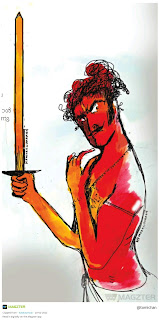


One of the shortest but classical works of fiction on the futility of revolution is George Orwell’s Animal Farm [1945]. The animals on the farm revolt against the oppressive human master and seek to establish an egalitarian society where all animals are equal. The revolution is driven by very noble ideals which have the potential to create a paradise on the farm. But sooner than later, the ideals give way to venality and the new rulers among the animals become far worse than the erstwhile human master. The human master only exploited the animals for labour. Now the animal masters are utterly vicious. They enjoy the highest forms of luxury at the cost of the other animals which are treated as worse than slaves. There is not only inequality but also injustice, cruelty, violence, government’s surveillance on the citizens, and plain butchery.

It was the aftermath of the Russian Revolution that inspired Animal Farm. The Russian Revolution sought to replace the dictatorial Tsar with a people’s government founded on socialist ideals. What Russia got, however, was a government far more inhuman than the Tsarist one. Something very similar happened with the French Revolution too which began in the name of the noble ideals of liberty, equality and fraternity.

Revolutions are too idealistic to be practical. That is why the great thinker and writer, Albert Camus, said that revolutions culminate inevitably in police or in folly. The kind of perfection quested after by revolutions is impossible in the human world. The humankind has not evolved yet to that level of sophistication (emotional, intellectual and spiritual) required to create such paradises on earth. The human is far too fallible for that. Too frail. Too guilt-ridden.

The human fallibility, frailty and guilt require gods. To fear and worship. To forgive and give a pat on the back. To take revenge on the enemies, whole races of them if possible.

It is not Ram Rajya that the bhakt quests after. It is Ram – with all his might and hate and vengeance. Let us build glorious temples for him. Let us sacrifice fellow beings for him.

“All animals are equal, but some animals are more equal.” That is how one of the ideals in the revolutionised Animal Farm of Orwell had metamorphosed under the new leaders.  

PS 1. This post is provoked by a Facebook visitor to my space who told me bluntly that I, being a non-Hindu, am “only an unwanted guest” in his country which was destined to become Ram Rajya under the present political leadership.

PS 2. Thank you Blogchatter for the following award.



Comments

  1. Brilliant. I really enjoyed this piece. It triggered another thought in my mind, something similar that I shall soon share. Sometimes I think we are all in a spiral, and there's no one better than the other. I am so sorry about the Facebook trolling. It's become some sort of culture. Congratulations for the award.

    ReplyDelete
    Replies
    1. Thanks, Sonia. Don't worry about the FB thing, I've got used to that sort of things. I look forward to your post on "something similar".

      Delete
  2. Hari OM
    Interesting you should use Animal Farm (and appropriately, I may add)... have you seen the news that in some of the [dis]United States, there is a move to ban books because they are perceived as having potential to 'misguide our youth'? (An article on this...) Driven by fear of the mighty word, requiring the censorship sword???

    Congrats on being recognised for your contribution at Blogchatter! YAM xx

    ReplyDelete
    Replies
    1. It's rather odd that the US is seeking to ban books. They're supposed to be liberal, aren't they?

      Delete
  3. Interesting post. I don't think bhakts quest after Ram too. In fact i think they don't even know Ram because what they are doing is directly opposite to what Ram stood for. Facebook trolls are funny things. I have lost count how many times i have been called a Vampanthi (communist). Congratulations on winning top blogger award.

    ReplyDelete
    Replies
    1. Those who really know their god and religion won't indulge in hatred and violence.

      I take trolls in my stride, no problems. 😊

      Thanks.

      Delete

Post a Comment

Popular posts from this blog

The Adventures of Toto as a comic strip

  'The Adventures of Toto' is an amusing story by Ruskin Bond. It is prescribed as a lesson in CBSE's English course for class 9. Maggie asked her students to do a project on some of the lessons and Femi George's work is what I would like to present here. Femi converted the story into a beautiful comic strip. Her work will speak for itself and let me present it below.  Femi George Student of Carmel Public School, Vazhakulam, Kerala Similar post: The Little Girl

Re-exploring the Past: The Fort Kochi Chapters – 4

The footpath between Park Avenue and Subhash Bose Park The Park Avenue in Ernakulam is flanked by gigantic rain trees with their branches arching over the road like a cathedral of green. They were not so domineering four decades ago when I used to walk beneath their growing canopies. The Park Avenue with its charming, enormous trees has a history too. King Rama Varma of Kochi ordered trees to be planted on either side of the road and make it look like a European avenue. He also developed a park beside it. The park was named after him, though today it is divided into two parts, with one part named after Subhash Chandra Bose and the other after Indira Gandhi. We can never say how long Indira Gandhi’s name will remain there. Even Sardar Patel, whom the right wing apparently admires, was ousted from the world’s biggest cricket stadium which was renamed Narendra Modi Stadium by Narendra Modi.   Renaming places and roads and institutions is one of the favourite pastimes of the pres...

Good Life

I introduced A C Grayling’s book, The God Argument , in two earlier posts.   This post presents the professor’s views on good life.   Grayling posits seven characteristics of a good life.   The first characteristic is that a good life is a meaningful one.   Meaning is “a set of values and their associated goals that give a life its shape and direction.”   Having children to look after or achieving success in one’s profession or any other very ordinary goal can make life meaningful.   But Grayling says quoting Oscar Wilde that everyone’s map of the world should have a Utopia on it.   That is, everyone should dream of a better world and strive to materialise that dream, if life is to be truly meaningful.   Ability to form relationships with other people is the second characteristic.   Intimacy with at least one other person is an important feature of a meaningful life.   “Good relationships make better people,” says G...

Re-exploring the Past: The Fort Kochi Chapters – 1

Inside St Francis Church, Fort Kochi Moraes Zogoiby (Moor), the narrator-protagonist of Salman Rushdie’s iconic novel The Moor’s Last Sigh , carries in his genes a richly variegated lineage. His mother, Aurora da Gama, belongs to the da Gama family of Kochi, who claim descent from none less than Vasco da Gama, the historical Portuguese Catholic explorer. Abraham Zogoiby, his father, is a Jew whose family originally belonged to Spain from where they were expelled by the Catholic Inquisition. Kochi welcomed all the Jews who arrived there in 1492 from Spain. Vasco da Gama landed on the Malabar coast of Kerala in 1498. Today’s Fort Kochi carries the history of all those arrivals and subsequent mingling of history and miscegenation of races. Kochi’s history is intertwined with that of the Portuguese, the Dutch, the British, the Arbas, the Jews, and the Chinese. No culture is a sacrosanct monolith that can remain untouched by other cultures that keep coming in from all over the world. ...

Yesterday

With students of Carmel Margaret, are you grieving / Over Goldengrove unleaving…? It was one of my first days in the eleventh class of Carmel Public School in Kerala, the last school of my teaching career. One girl, whose name was not Margaret, was in the class looking extremely melancholy. I had noticed her for a few days. I didn’t know how to put the matter over to her. I had already told the students that a smiling face was a rule in the English class. Since Margaret didn’t comply, I chose to drag Hopkins in. I replaced the name of Margaret with the girl’s actual name, however, when I quoted the lines. Margaret is a little girl in the Hopkins poem. Looking at autumn’s falling leaves, Margaret is saddened by the fact of life’s inevitable degeneration. The leaves have to turn yellow and eventually fall. And decay. The poet tells her that she has no choice but accept certain inevitabilities of life. Sorrow is our legacy, Margaret , I said to Margaret’s alter ego in my class. Let...