
When symbols replace values
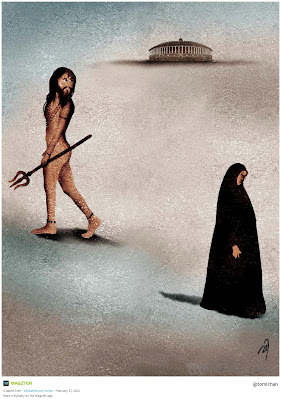
Symbols

“Are you a good Muslim?” A student asked Ziauddin Sardar.

Ziauddin Sardar is a writer born in Pakistan and living in England. He is a multi-faceted personality who has made a mark as a scholar, cultural critic, and an intellectual who specialises in Muslim thought. [Now don’t ask me whether Muslims think. Some of them do, I assure you.]

The above question was hurled at Sardar when he visited a madrasa in Pakistan in 1985. Let me quote a part of that conversation from his book Desperately Seeking Paradise. [The quotes are not verbatim.]

Student: Are you a good Muslim?

Sardar: I am a Muslim. Good or not, I don’t know.

Student: If you are a Muslim, why don’t you grow your beard?

Sardar: A beard is not a necessary mark of a Muslim.

Student: The beard is an essential part of the Prophet’s Sunnah. Those who disregard the Sunnah are not good Muslims.

Sardar: Do you use a camel for your travels? Do you ride on a camel’s back?

Student: What do you mean?

Sardar: The camel is Sunnah because the Prophet used the camel for his travels.

Student: But we have cars and buses today. Why would I use a camel?

Sardar: Exactly. If there was a safety razor in those days, the Prophet would have shaved off his face hair too.

All gods and their scriptures belong to specific periods of history. What the Prophet said and did in his time is no more valid today than what Jesus or Krishna or the Buddha said and did in their times. The time has changed. The old gods and their prophets have become outdated. No scripture can ever be eternally valid. No religion can make sense to intelligent people unless it adapts itself to the changing times. Most parts of the Bible and the Koran and the Upanishads or the Gita or any scripture will be rubbished today by any thinking brain.

If those ancient and outdated and absurd scriptures continue to rule us today, it is because we haven’t learnt to think. We are still idiots. We are governed by idiots who love riots and wars. Idiots who wear fancy dresses. Idiots who want to capture nuclear stations. Some idiots have teashops to boast about. Some have Rasputin. Most have a god, one god, their own god, their own ego.

Egos of certain individuals replace the essential teachings of religions. That is how a religion dies. The hijab is a symbol. The saffron is a symbol. It is very easy to make people fight in the name of symbols. Idiotic leaders do just that: make people fight in the name of symbols.

Tail question: Why doesn’t the world ever go beyond stupid leaders?

Answer: No leader can be greater than their people.

Comments

  1. Religions are weapons. It achieve different things when different people handles it. Gandhi used to infuse a sanctify any tasks he was doing/he wanted others to practice. The same tool is being used now to deviate people from real time issues by relevant parties.

    ReplyDelete
    Replies
    1. This post was written in some frustration and so there are exaggerations. Gandhi was a great leader who towered above the masses. But there are so few leaders like him in the entire human history.

      Delete
  2. Where the population doesn't evolve in thinking, past rules them and leaders become their Gods.

    ReplyDelete
    Replies
    1. True. We make tremendous progress in science and technology, but not one step ahead in evolved thinking!

      Delete
  3. I think having an open mind and access to good education is key when it comes to changing the inert way we think and perceive things

    ReplyDelete
    Replies
    1. The problem with education is that the educators themselves may be perverse and bigoted!

      Delete

Post a Comment

Popular posts from this blog

The Adventures of Toto as a comic strip

  'The Adventures of Toto' is an amusing story by Ruskin Bond. It is prescribed as a lesson in CBSE's English course for class 9. Maggie asked her students to do a project on some of the lessons and Femi George's work is what I would like to present here. Femi converted the story into a beautiful comic strip. Her work will speak for itself and let me present it below.  Femi George Student of Carmel Public School, Vazhakulam, Kerala Similar post: The Little Girl

Re-exploring the Past: The Fort Kochi Chapters – 4

The footpath between Park Avenue and Subhash Bose Park The Park Avenue in Ernakulam is flanked by gigantic rain trees with their branches arching over the road like a cathedral of green. They were not so domineering four decades ago when I used to walk beneath their growing canopies. The Park Avenue with its charming, enormous trees has a history too. King Rama Varma of Kochi ordered trees to be planted on either side of the road and make it look like a European avenue. He also developed a park beside it. The park was named after him, though today it is divided into two parts, with one part named after Subhash Chandra Bose and the other after Indira Gandhi. We can never say how long Indira Gandhi’s name will remain there. Even Sardar Patel, whom the right wing apparently admires, was ousted from the world’s biggest cricket stadium which was renamed Narendra Modi Stadium by Narendra Modi.   Renaming places and roads and institutions is one of the favourite pastimes of the pres...

Re-exploring the Past: The Fort Kochi Chapters – 3

Street leading to St Francis Church, Fort Kochi There were Christians in Kerala long before the Brahmins, who came to be known as Namboothiris, landed in the state from North India some time after 6 th century CE. Tradition has it that Thomas, disciple of Jesus, brought Christianity to Kerala in the first century. That is quite possible, given the trade relationships that Kerala had with the Roman Empire in those days. Pliny the Elder, Roman author, chastised in his encyclopaedic work, Natural History (published around 77 CE), the Romans’ greed for pepper from India. He was displeased with his country spending “no less than fifty million sesterces” on a commodity which had no value other than its “certain pungency.” Did Thomas sail on one of the many ships that came to Kerala to purchase “pungency”? Possible.   Even if Thomas did not come, the advent of Christianity in Kerala precedes the arrival of the Namboothiris. The Persians established trade links with Kerala in 4 ...

Five Microtales

1.        Development             Chamar, Lohar, Mehtar and many others stood at a distance, along with their families, and watched their huts being pulled down by a bulldozer. They were asked to leave the place where they had been living for decades. “The government has taken over this land for development works,” an officer said. Chamar, Lohar, Mehtar and the others spread their bedsheets under a flyover over which flew opulent vehicles of development.   2.        Impersonation             The old woman went to the Women’s Welfare office. She wanted to register herself for the Prime Minister’s monthly welfare scheme for the old and unemployable women. She placed her thumb on the scanner for Aadhar authentication. “Not matching,” the officer said. She was arrested for trying to impersonate. Sitti...

Re-exploring the Past: The Fort Kochi Chapters – 1

Inside St Francis Church, Fort Kochi Moraes Zogoiby (Moor), the narrator-protagonist of Salman Rushdie’s iconic novel The Moor’s Last Sigh , carries in his genes a richly variegated lineage. His mother, Aurora da Gama, belongs to the da Gama family of Kochi, who claim descent from none less than Vasco da Gama, the historical Portuguese Catholic explorer. Abraham Zogoiby, his father, is a Jew whose family originally belonged to Spain from where they were expelled by the Catholic Inquisition. Kochi welcomed all the Jews who arrived there in 1492 from Spain. Vasco da Gama landed on the Malabar coast of Kerala in 1498. Today’s Fort Kochi carries the history of all those arrivals and subsequent mingling of history and miscegenation of races. Kochi’s history is intertwined with that of the Portuguese, the Dutch, the British, the Arbas, the Jews, and the Chinese. No culture is a sacrosanct monolith that can remain untouched by other cultures that keep coming in from all over the world. ...